
A Brief History of Staunton Elks Lodge #351
To better understand the history of Staunton Elks Lodge #351, we should remember that in the late 19th Century, fraternal organization flourished across the nation and functioned largely as social networks and mutual aid societies for their members.
Staunton was a thriving community in the late 19th Century. Staunton had to overcome a very destructive 1896 flood, but began the 20th century with a new five-and-a-half-mile streetcar system in addition to a large supply of new and beautifully restored buildings thanks to the talented architect T.J. Collins. The description given for Staunton in Chataigne’s Augusta County, Virginia Gazetteer and Classified Business Directory for 1888:
“Population 1887: over 10,000
Vote November 2d 1886: Democrats 598, Republicans 557
Value of real estate 1886: $1,746,919.00
Value of personal property: $641,689.00
Tax on real estate: $6,988.18
Tax on personal property: $2,750.63
Capitation tax: white- $888, colored- $418”
In 1888 Staunton was the largest city in the Shenandoah Valley and the eighth largest city in Virginia. Served by the Chesapeake and Ohio and the Valley branch of B&O railways as well as a major wagon trail (now U.S highway 11), Staunton had a well developed hospitality industry with ample hotel accommodations. The community had met the population threshold of 5,000 to be eligible to petition the Grand Lodge for a Charter to establish a local Elks Lodge of the Benevolent Protective Order of the Elks (B.P.O.E.).
Although many fraternal lodges existed in Staunton in 1896, a local lodge of the Benevolent Protective Order of the Elks (founded in 1868.) had not yet been established. The Grand Lodge had been in existence for 28 years when Stanton Elks Lodge #351 became the 351st local Elks Lodge to be granted a charter by the Grand Lodge of the Benevolent and Protective Order of Elks.
1896
A Lodge of Elks was organized on August 7, 1896 in the City of Staunton in the Improved Order of Red Men’s Hall. The lodge began existence with 30 members. The instituting officers for Lodge 351 were from Richmond, VA and were lead by Thomas W. Leath , Grand Exalted Ruler of Virginia.
The following officers were selected for the Staunton Lodge:
W. F. Summerson, Exalted Ruler
John McQuaide, Esteemed Leading Knight
Thomas J.Crowder, Esteemed Loyal Knight
Dr. M. O. Burkholder, Esteemed Lecturing Knight
Heber Ker, Secretary
M. Valz, Treasurer
A. Thomas Kivlighan, Tiler
John B. Guntner, Trustee
M. Hounihan, Trustee
J. J. Kilgallen, Trustees.
On August 7, 1896, the above Instituting Officers were honored at a banquet at the Virginia Hotel. The “Richmond State” (Richmond Lodge’s newsletter) recognizing the trip of the instituting party to Staunton stated “The Richmond Elks are loud in their praises of the new Staunton brethren and predict a big future for the Staunton Lodge, which starts with a membership of thirty-five.”
Newspaper articles on the organization of Lodge #351 appeared in the Staunton Spectator on August 12, 1896 and the Staunton Vindicator on August 14, 1896. And thus, the general public first became aware of a fine new lodge organization. Staunton Lodge #351 had its first lodge rooms in rented quarters- the back portion of the top floor of the Crowle Building on W. Beverly Street. When Lodge 351 was barely two months old, the Crowle building was severely damaged by a flood on September 29th. One whole corner wall of the room collapsed and the significance of flood damage remained visible even after the wall was rebuilt. The lodge room is still intact at this writing because other lodges and organizations have secured it as a lodge hall over the years, notably the Odd Fellows and the Knights of Pythias. The original inner door is still in place.
Lodge records indicate that by the end of 1896, a total of 38 members had been initiated. The oldest member was 59, the youngest 23 and the median age of the membership was 40. Occupations of the members included eight merchants, eight clerks, two contractors, two traveling salesmen, two managers (one managed the Globe Brewery), the City Superintendent of Streets, the City Commissioner of Revenue, one clerk-bookkeeper, a city sergeant of police, a deputy sheriff, a physician, a druggist, an attorney, a hotel proprietor, an insurance agent, a ticket broker, a plasterer (for both plain and ornamental plastering), a plumber and the janitor of the Opera House.
1897 to 1911
The Lodge membership continued to grow. By December 1903, 197 members had been initiated. The membership rolls included 11 lawyers,, 5 physicians, a judge, a justice of the peace, several city and county commissioners and a 22 year old actor.0
In 1898 Lodge #351 acted as the sponsor for the formation of Lodge #450 in Harrisonburg, VA. This marked the beginning of a special relationship between the two lodges that lasted well into the 21st century.
“On Sunday, December 3, 1911 Lodge #351 conducted a memorial service at the Beverly Theater. The program for the occasion listed 236 members and 23 deceased members. Three of deceased members served as Lodge officers in 1896. The program included music provided by the Stonewall Jackson Band, the Union Chorus and a soloist from Washington, D.C.”
1912 to 1922
Over the years as economic conditions changed, the fortunes and roles of the various fraternal lodges in the community would ebb and rise. Some lodges would dwindle and move to smaller, more economical quarters while other lodges would prosper and move into their own building. By 1911 Lodge #351 had become strong enough financially to build its own building.
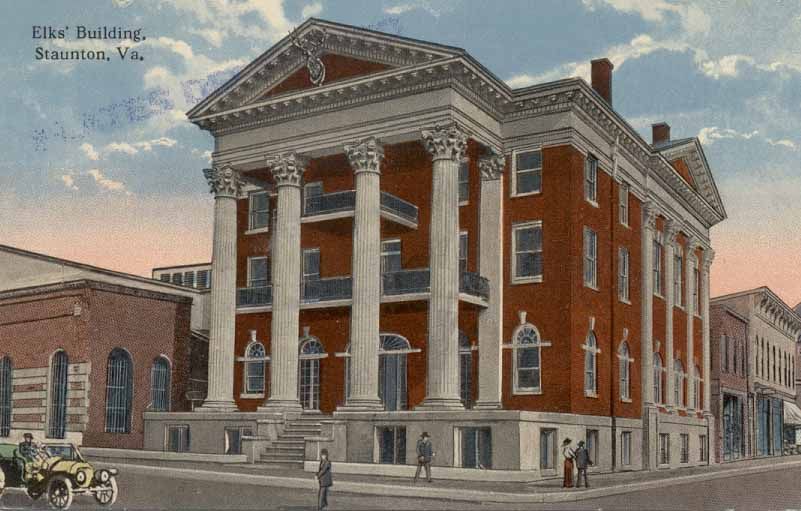
Under the leadership of Harry P. Harlow, Exalted Ruler, land was purchased at the corner of Central Avenue and Frederick Street. Prominent Stanton architect , T.J Collins ,was commissioned to design the building. Common to the practice of the day, the design was for a multi-story building with the lodge rooms on the upper floors and office space on the lower floor to rent and provide income for the lodge.
The cornerstone of the new building was laid on October 17, 1912. The Staunton Daily News gave the following account of the cornerstone laying ceremony on October 18, 1912:
“LARGE CROWD SEES PLACING OF STONE
Staunton Lodge Elks Hold Ceremonies at Their Fine New Lodge Building
With Lodge members occupying a platform that later is to be the spacious Colonial porch of their handsome building, a crowd numbering several hundred lining the sidewalks and streets, the cornerstone of the new Elks’ Home was laid last evening, marked with impressive ceremonies at which Exalted Ruler H.H. Harlow presided.
Headed by the Stonewall Band, which also rendered several appropriate selections during the evening, the Brothers left their present quarters in the Crowle Building at a few minutes past 7 o’clock and marched direct to the corner of Central Avenue and Fredrick Street, at the northwest intersection of which thoroughfares the culmination of many years successful organization is now in the course of construction.”
The newspaper article continues with a description of the articles placed in the cornerstone and concludes the article with this account of Captain Carter Braxton’s address to the crowd:
“Descriptive of the Benevolent and Protective Order of the Elks, its humble beginnings locally, and the splendid organization that has been built up, Brother Carter Braxton’s address followed. He touched on many phases of the work that had been done with a brief outline of magnificent principles on which the lodge is founded. How a room with an extension table and a few other articles of furniture led to the borrowing of a thousand dollars to equip more commodious quarters, the joyous occasion when the last cent of this indebtedness had been paid and the inception and completions for the plans for the new and modern Home were told in a way that impressed his hearers with the steady growth and advancement of the Antlered Tribe, a tribute to Mr. Harlow, to whose energy and devotion so much of this was due being included in the address. Music, then the pronouncement of brother L.G. Strauss that the cornerstone was in place and the exercises were over, the band leading the way to the Crowle Building, where a delighted smoker was engaged in the present Lodge room.”
The last social session held at the Crowle Building was on February, 1913 and was a “phonograph concert”, where a new Columbia phonograph presented a variety of music of the day. According to front page coverage in the local newspaper, “The members and their guests were treated to a broad selection of music on this spring-wound record player.”
The lodge opened its doors at the Central Avenue and Frederick Street location on May 1, 1913. On May 2nd the Staunton Daily News reported:
“STAUNTON B.P.O.E. IN NEW QUARTERS
Last night was a big night for Staunton Elks. While two or three weeks’ work remains to be done, their new Home is so near completion that the regular meeting was held there last evening. Lighted up, the new Home presented a most inviting appearance. While it will be of chief benefit to the members of the popular order, of course, the new Home will be appreciated also by the general public for the reason that it will at night afford one bright spot on a thoroughfare which heretofore always appeared gloomy at night.”
In their new quarters, Lodge #351 continued to prosper and be a prominent Fraternal Organization in Staunton.
An example of a major social and fundraising activity of the times was the big minstrel show in March of 1916 at the Virginia Theater in Harrisonburg. This was a joint venture between Staunton Lodge #351 and Harrisonburg Lodge #450. Everyone rode to Harrisonburg on the train to the show and the Director of the Orchestra for the show was Thomas Beardsworth, Director of the Stonewall Jackson Brigade Band.
In 1918 Lodge #351 had 200 members. The membership continued to decline in 1919 to 130, and dwindled to 104 in 1920 and 97 in 1921. In April of 1919, the Elks Building was sold to the Erskine Coal and Land Company. Although there was some thought that Lodge #351 would dissolve, in August of 1919 the organization moved into rented quarters in the Gooch Building with Samuel Weinberg as Exalted Ruler.
On April 1, 1922, the decision was made to put the Lodge into hibernation. The Lodge Charter was surrendered to the Grand Lodge effective July 1, 1922.
The reason for the decline in membership of the lodge has been lost to history. Speculation of possible causes could include a post World War I economy, the national implementation of prohibition on January 18, 1919, and a possible leadership vacuum in the Lodge. After World War I, technology began to change the way people socialized and how they entertained themselves. Automobiles and good roads began to change the way they traveled. Movies and radio began to replace the minstrel shows for entertainment. In most places, it became uneconomically difficult to maintain large and fancy overnight accommodations in private clubs.
1923 to 1954- The Dormant Years
Over the years from 1923 to 1954, a local legend developed that Lodge #351 had lost its charter in 1922 because of some improper action involving prohibition issues. This was not the case. In his January 23, 1996 letter, Mike Kelly, Grand Lodge Historian, states, “In the 1922 Grand Lodge Proceedings, the GER said there was one Lodge which had a problem with regard to prohibition and three Lodges had their charter revoked including Lodge #351. The Lodge membership declined for some reason: in 1918 they had 200 members, 1919-130, 1920-104, 1921-97.”
In 1935, the remaining money in the treasury from the sale of the Elks Building was used to buy 12 cemetery plots at Thornrose Cemetery to establish an Elks Rest.
By 1954, Staunton was once again ripe for the establishment of an Elks Lodge. In a November 12, 1954 letter to the Grand Lodge Secretary, Porter R. Graves of Harrisonburg Lodge #450 urged the expediting of the the formation of a Lodge. He wrote, “They have excellent membership material there, besides having a goodly number of Elks who are profoundly interested in doing something toward the re-establishment of a Lodge there.
Also I am greatly interested in getting at least one new Lodge formed in Virginia this year, as Virginia has only established two new Elks Lodges in the last forty odd years. Further, there is growing hope that Virginia is in line for the next Grand Exalted Ruler, and I want to do everything possible to aid the nomination and election of Brother John L. Walker of Roanoke as our next Grand Exalted ruler.”
1955- Lodge #351 Revived
On June 7, 1955, the new dispensation was approved and the new Charter was reactivated on July 14, 19S5. The September 1955 edition of Elks Magazine reported:
“Elks Lodge Established
In Staunton, Virginia
Staunton Lodge #351 came into official being recently at the Veterans Home, when a large delegation of Elks from neighboring lodges were on hand. The capable Ritualistic Team from sponsoring Harrisonburg Lodge #450 initiated 86 Charter Members in honor of its own E.R, Porter K. Graves, Chairman of the Va. Elks Assn’s New Lodge Committee, who also participated as Master of Ceremonies.
As Staunton’s first Exalted Ruler, J. Paul Tribes outlined the plans for the programs his Lodge will undertake, and then introduced John L. Walker, later elected as the Order’s 1955-56 Grand Exalted Ruler, who delivered a brief address on the Elks National Foundation.”
In 1896 Staunton Lodge #351 sponsored Harrisonburg Lodge #450. Fifty-seven years later, Lodge #450 became the sponsoring Lodge of their sponsor which made for an unique relationship between the two lodges that is perhaps unduplicated in Elkdom.
The first meeting place under the new charter was at the old pump house at Gypsy Hill Park. Only a few meetings were held there before the City of Staunton decided to use the pump house for the Stonewall Brigade Band and Staunton Fine Arts Center. Lodge #351 then moved to the main floor of the Wautauga Hotel at 20½ S. New Street.
The Flood of 1896:

A major flood on September 29, 1896 a major flood caused extensive damage throughout the Wharf and downtown area including the Crowle Building to the right. Lodge #351 had their rooms on the top floor. The gaping hole on the top floor is the location of the Exalted Ruler’s room. The back corner was rebuilt and the structure survives today. This view is looking north on S. Central Avenue.
The Elks Building:
The Elks was just one of several fraternal organizations who occupied large buildings in Staunton in 1913. The structure was designed by T.J. Collins in 1912 and was built in the Beaux Arts tradition and boasted a monumental portico with elaborate Corinthian columns. It was constructed of contrasting red and cream colored brick and limestone trim, similar to the treatment used for the Augusta County Courthouse. Its columns were comprised of large blocks of molded cream colored terra cotta, which resembles stone but was less expensive. A giant elk’s head projected from the pediment of the porch, which is the only major feature of this building that no longer survives today. Like most other fraternal organizations that built there own buildings in Staunton, this one housed not only meeting space for the elks, but office space that they leased for income.
The building featured elaborate door hardware of an elk head and a clock with the hands on 11:00 o’clock. This hardware remains on the entrance doors in 2009.
What’s in the Cornerstone?
The Staunton Daily News on October 18, 1912 gave the following account of contents of the cornerstone:
“Queer Collection,
These articles were placed in the cornerstone to lay undisturbed through decades and then to be resurrected by some future generation to be studied and still further preserved as relics of some bygone days: Copies of rules governing the Home, list of members, officers and committees, to-date, by Hulet Glenn, Secretary; list of charter members and past Exalted Rulers, by N.C. Watts; program of the first memorial services, by H.H. Harlow; menu cards of the banquets given by the Lodge on August 7, 1896 and February 6, 1898, by Mr. Harlow; program of the memorial service of 1911, by Mrs. M.H. Sutton; memorial of the Barth-Weinberg Company; portrait of Exalted Ruler Harlow; coin, by W.T. McCue; program of the Beverly Theater; Mexican dollar, by A.A. Esteridge, Past Exalter ruler; Grand Lodge Badge of 1907, by Dr. Glasgow Armstrong; State convention badge of 1912, by A. Y. Pfifferling; souvenir;, by A.M. Kerr; Constitution of Workingmen’s Fraternal organization, half dollar coinage of 1853, by C.A. Newhaus who also deposited a check for fifteen cents and a copy of “Tom Burke of Ours”, printed in 1875. Other articles were coins of many nationalities and description; a Woodrow Wilson badge, the offering of Wash Cabell, Janitor of the Courthouse; pictures of the Elks’s Local and national Homes and rosters of local lodges other than B.P.O.E.”
Information compiled by:
Edgar Jones, III, Lodge Esquire:

Most of the material in this account of the history of Lodge #351 is the result of research by Edga r “Ed” Jones.
Ed Jones has been a member of Lodge #351 since 1970 and has served as Lodge Esquire since 1980 which makes him the longest continuously serving Officer in Lodge #351. In 2007 he was voted a Life Member in Lodge #351.
Ed has lived in Staunton area since 1950 when he was a cadet at Augusta Military Academy. He has an avocation to, “Make old things work.” An example of this avocation is a restored 1929 Model A (pictured above) that he drives almost daily around town. On his Lodge history research, he says, “I like to know the history of this organization because I’m part of it and it’s relevant.”
If you have questions or comments about this page or wish to add new information to the historian’s store of facts and figures about Staunton Elks 351, email the historian at historian@stauntonelks351.org.
